
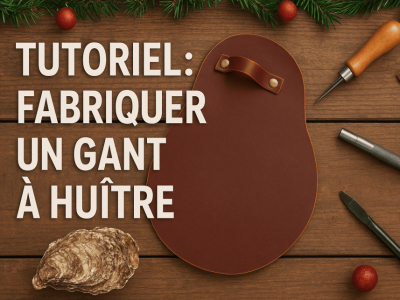
Why make a leather oyster glove?
Leather is an ideal material for protection when opening oysters: it combines strength, durability and comfort. Making your own glove allows you to adjust the size, thickness and sturdiness according to the shape of your hands. This project is accessible and quick if you follow the steps in order.
Find the full YouTube video just below. The free downloadable pattern is available in the “Required Materials” section.
Required materials and tools
- Glove pattern (downloadable) — Download the pattern
- Leather (1.8 to 2.5 mm recommended, semi-rigid cowhide)
- Precision knife
- Metal ruler and cutting mat
- Silver marking pencil
- Round hole punches
- Edge beveler
- Rivets + rivet setter
- Anvil and mallet
Manufacturing steps
Step 1 — Download and cut out the pattern
Print the pattern provided in the video description. Cut out each piece precisely using a precision knife and a metal ruler. Use a cutting mat to protect your surface and ensure clean cuts.
Tip: You can increase the pattern size up to 115% when printing to better fit your hand.

Step 2 — Transfer the pattern onto the leather and punch the holes
Position the pattern pieces on the leather and trace the outlines with a silver marking pencil, especially useful on dark leather as the line remains visible without leaving a permanent mark.
Use the proper placement of your pattern to punch the holes that will be used to set the rivets.
Tip: You can easily hold your pattern in place with an anvil or a small weight.

Step 3 — Cut the leather
Cleanly cut the final pieces by following the traced lines.
Step 4 — Bevel the edges
Run the edge beveler along the edges to slightly round and soften them, making the piece more comfortable against the skin.
Tip: Bevel both sides of your piece to properly soften the edges.

Step 5 — Set the rivets
Assemble the pieces by placing the rivets in the pre-punched holes. Place the piece on the anvil, position the rivet post, then flatten it using the setter and the mallet. Here, we used T3 rivets.

Expert tips
- Choose sturdy leather between 1.8 and 2.5 mm thick for the right balance between protection and comfort.
- Always test the rivets and tools on a scrap of leather before working on the final piece.
- Clean the leather after use with a damp cloth; avoid harsh chemical products if the glove comes into contact with food.